Showing posts with label gingerbread. Show all posts

Tuesday, January 7, 2014

Gingerbread Unit Review

Gingerbread Fun

We read several different Gingerbread stories and compared and contrasted how they were they the same and different from each other.   The students also really worked hard on identifying characters, setting, problem, solution and details of the stories that we read.  We also did many different activities to make learning reading, writing, math and science concepts fun and meaningful for the student's during the month of December.  We wrapped up the unit by doing a Gingerbread hunt (the Gingerbread men ran away!).  Here are some pictures we took during the unit and descriptions of what the students learned during these activities.
 
 Some of the students made 3-D Gingerbread houses like they learned about in The Gingerbread Baby to learn about flat shapes (squares) and 3-D shapes (cubes).  This hands-on activities helped build fine motor skills while reinforcing math concepts.  This activity also helped them recall details from one of our gingerbread stories.

 
 Many of the children became frustrated trying to make the graham crackers stick together and used problem solving skills, team work and advanced vocabulary while trying to figure out ways to engineer their structures.


We also did a non-standard measurement unit during December and it was easy to use our Gingerbread theme to help the students make connections.  The students used a variety of objects to measure items around the rooms.  One of the learning centers for math involved measuring Gingerbread cut outs of different shapes.  The students were encouraged to find different ways to measure the gingerbread men.  Math vocabulary such as length, width, height, are and perimeter were used during this activity.  We used different sized marshmallows over several days to show that measurement depends on your tools.

The students were also encouraged to make estimate how many marshmallows they thought it would take to measure.  They then had to fact check their estimation.  The students worked independently and in groups to do this exercise.

 
The students labeled the Gingerbread man during Writing Workshop to practice sounding out words and using labels to help the reader understand what they are writing.

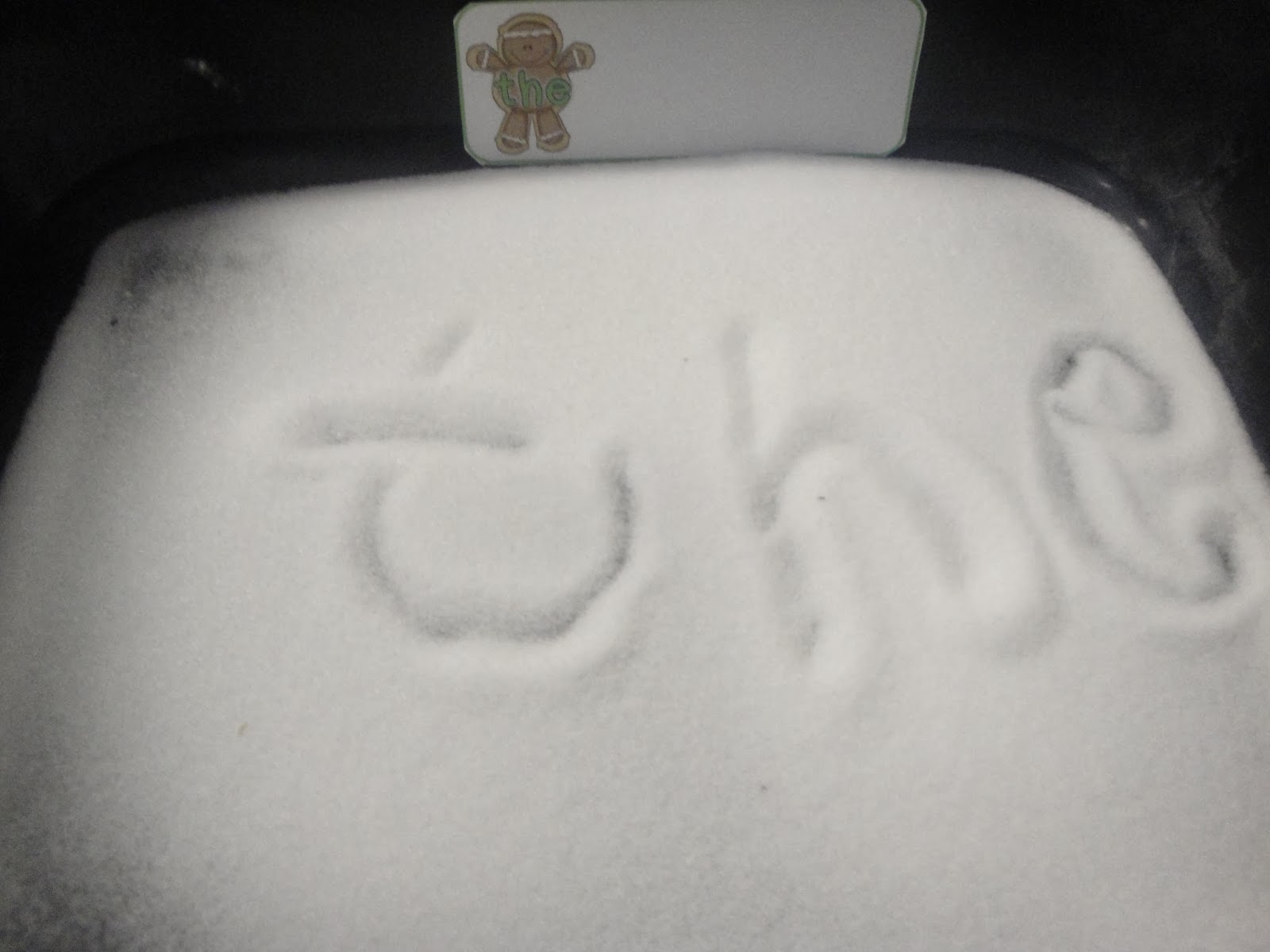
Salt was used as fake "snow" with alphabet and popcorn word cards to help students with letter formation and popcorn word recognition.  This made practicing these difficult fine motor skills much more fun!  Some used fingers and some used tongue depressors to write the words.


Pretend "gingerbread dough" in dramatic play and dough stampers were used to make words, blend sounds and practice popcorn words.

In dramatic play they re-enacted details from several of the gingerbread stories we read during Reading Workshop to increase comprehension skills, retelling in sequence, remembering details and using vocabulary to strengthen speaking and writing.
"Run, run, as fast as you can, you can't catch me I'm the Gingerbread Man!"
 
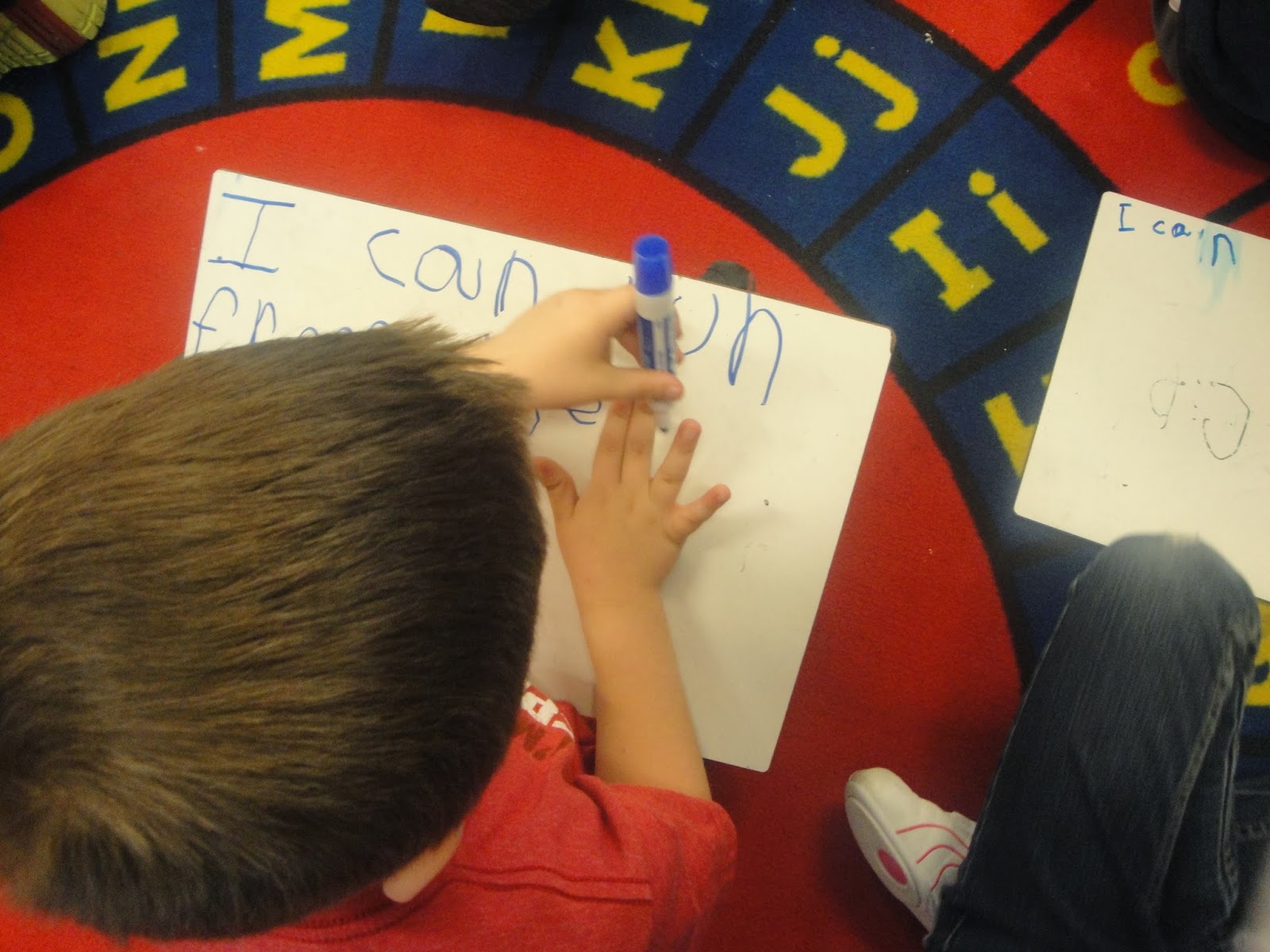
We started practicing the foundations of sentence structure in Writing Workshop making sure we put finger spaces between our words when writing.  We practiced as a group on write-on/wipe-off boards to understand how much space should be put between words so the reader can read our words.


To wrap up the unit we had a Gingerbread Tasting Party with Gingerbread Cookies, but before we could try them they ran away, just like in some of the books we read!
 

We came back from lunch and found crumbs where the cookies had been.  We searched all over the school looking for them!  They ran away from every Kindergarten classroom!

 We looked everywhere for clues to try to find them.  We observed liked scientists to try to figure out where they could have gone!
We made signs and posted them around the school like in the book The Gingerbread Man Loose In School that we read.


We built traps and placed animal crackers out like in The Gingerbread Girl Goes Animal Crackers hoping that having animal friends waiting for them might lure them back to our rooms!


We placed our Gingerbread Houses out hoping giving them a home like in one of our Gingerbread stories we read by Jan Brett would cause the Gingerbread Men to come back!

 
We made beautiful Gingerbread Houses for our cookies hoping they would like them and come back.

We made Gingerbread Friends for our Gingerbread boys and girls to play with in dramatic play hoping that would make our cookies want to come back.

 
In the end it worked and after Specials classes, when we returned, they had all come back to every Kindergarten Class!  They students were so excited.  What they had learned and remembered from reading all of those different Gingerbread books helped them solve a problem and find a solution, just like in the characters in the stories we read!  This was a great text to self connection.  It was also a great way to apply what they had learned to a real life problem and realize that what we learn in books can help us in our life and help us use that knowledge to solve problems.
 
 
These are some of the books we read during our Gingerbread Unit.  We used these books, which part of the Gingerbread Man we ate first and other fun concepts to reinforce what we had learned in math about graphing.  Below is one example of a graph we created in one of the classrooms.
 
In this graph the students voted on which Gingerbread book they enjoyed the most during the unit.  We then graphed each response to find out which story the class liked the most (expanding math vocabulary), the least, how many votes each book had, how many votes total and how many books all together and total.  This was a way to visually organize and compare their data!
 
The unit was a huge success and the students learned so much.  We hope you enjoyed this little view into some of our December learning objectives and we hope this gives you some ideas of how you can support these concepts at home.

Monday, December 9, 2013

A Little Elf and Gingerbread House Math

I love the Elf on the Shelf.  The kids get so excited.  I love the creativity of coming up with fun ways to display her.  The kids are excited to come in each morning and search for our Elf, Trinity (last years class named her and she came back this year).  I love that the First Graders (last years Kindergarten class) come in a couple of times a week to say hello to her and wish the new class a great day.  I thought I would share a picture of her and Pete the Cat having a snowball fight today.


We also do a great big Gingerbread Man unit this time of year (which I also love).  We compare and contrast all of the different Gingerbread stories we read.  We re-enact the stories in dramatic play, we graph our favorite stories as a class.  We work on rhyming, patterns in reading and patterning in math when we build our houses.  We will go on a school wide hunt searching for our run away Gingerbread cookies, we make posters trying to find them (writing) and we label and describe Gingerbread people.  Today we started building our Gingerbread houses and we learned about being architects.  We also reviewed the difference between 2-D and 3-D shapes (square versus cube, triangle versus triangular prism).  I watched them problem solve how to make their building stable, negotiate sharing materials, use expanded vocabulary to describe how they built their house and overcame the problem of the walls falling down, and how they supported and helped each other when they needed help.  I listened to them talk about the patterns they were creating in their decorations.  I sat back and watched and listened and glowed in the knowledge they did not need me during this project.  I watched in amazement at the 100% engagement, even though I ran out of Graham crackers and all the children could not participate.  I watched in amazement as one child offer another child their crackers and said they would wait until tomorrow to build their house.  The children that had to wait until tomorrow started sorting the candies the amazing parents donated for the children who were building their houses.  I dumped the whole bag on the floor and watched them work together to sort by color, type and size and place the items into containers they found in dramatic play to hold all of the treasures.  I watched them count, make groups of 10 and laugh as they worked together with their classmates.  This was truly a magical day as a teacher.  Some other teachers say I am crazy for doing this project.  Too messy, too much time, too much chaos, but I would not teach any other way.  There were so many concepts being APPLIED.  Math, language, social skills, fine motor, vocabulary, story retelling.  But mostly I watched their minds growing, their imaginations taking off, I watched them learn, teach and mostly be the kind of learners and team mates that I am proud to say will lead our future.  Here are some pictures.  I hope you enjoy them.  I leave you with this thought, do messy projects that require the students to problem solve.  Get away from the worksheets.  Let go a little bit and watch the wonders of learning.  Play with a purpose.  Know what skills you want them to master, give a guide for reference, but not step-by-step instructions.  Let them struggle.  Let them use their brains.  Let them play.  Let them play.  Let them play.  That is when the true magic of learning occurs.  That is when the brain grows in amazing ways.  Let them be excited to learn by letting them be present in the experience.  Make it interesting, make it sensory, make it messy, make it meaningful.
Do you see the pattern work this child is doing?  ABAB around the plate he said as he was placing the candies in the yard.

This child tried four times to make the house.  It fell in three times before they finally figured out how to add icing (glue they called it) to fill in the cracks.  The interesting part was they referenced the Laura Ingalls Wilder books when Pa built the little house in the big woods out of logs and had to fill in the cracks.  Then they filled in the cracks with more icing and it worked!  I loved that this child made a connection from a story read in the fall. 

This child did not want a roof.  He had one, but he took it off.  I love that he was independent and knew he was safe to create his house his own way.  He wanted to use the sprinkles but could not apply the icing to the slanted roof so he made a flat roof that he could spread icing on without the structure falling into itself.  He said Santa could have a party on that roof!

This child was so interested in the fact that it took six squares to make a cube.  This child also listened to the other child at the table talking about filling in the cracks like Pa and said "That is a great idea, I am going to do that too!".

This child has a hard time writing but can read like nobodies business!  He struggled trying to get all of the pieces to stay together.  This was a very challenging project for him, but he did not give up.  He asked another child that had completed his house to come and help.  They talked about structure, and making things strong and the importance of where to place the icing.  This child said they wanted to be an architect when they grow up.


This was my guide piece.  During large group instruction I showed how to construct a cube and a triangular prism (yes, I use those words and so do they).  They were concerned about how to fill in the roof so I stuck a gingerbread cookie there and secured it with icing.  We talked about the importance of not eating the icing and candies (germs you know) and I let them know that I had a separate stash for eating.  We used Popsicle sticks to get our icing out of the container and we did NOT lick the stick (at least I didn't catch anyone doing that).  There was a great deal of finger licking though when the structures were finished.

The beginning of the process.  Each child had to count out the correct number of crackers needed (six for the house plus two for the roof means eight total).  Then they had to start talking about how to construct their houses.  It was so interesting to listen to their reasoning about how the house should be made.  This child said you needed the floor first so the walls had something to hold on to.

These are the students that did not get to make their houses today.  They are working together to sort, separate and store the donated left over Halloween candy graciously given to us by one of the parents.  The discussion on how to do this was priceless.

They used mats to sort by candy type.  I thought that was very smart problem solving.

Fine motor practice at it's finest!  There is nothing like icing to sweeten up a math lesson!